
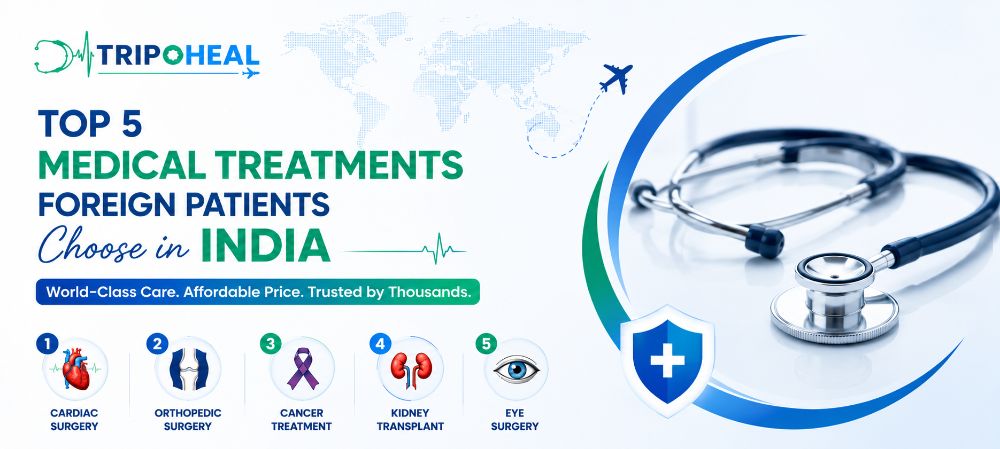
Top 5 Medical Treatments Foreign Patients Choose in India
Patients from the US, UK, Canada, Nigeria, Kenya, and the Gulf regularly travel to India for cardiac surgery, organ transplants, oncology, orthopedics, and fertility treatment. The cost savings are significant: a heart bypass that costs $80,000–$100,000 in the US starts at roughly ₹2,50,000–₹3,50,000 (about $3,000–$4,200) in Indian private hospitals, and comparable savings apply to kidney transplants and cancer care. Demand for orthopedic surgery in India among international patients has also surged, driven by world-class joint replacement and spine programs that deliver outcomes on par with Western centers at a fraction of the price. Cancer treatment, too, has grown rapidly as a draw for overseas patients, with leading oncology centers combining advanced technology and highly trained specialists at costs that Western hospitals simply cannot match.
Based on cases coordinated at Tripoheal, patients are not choosing India as a last resort — they research outcomes and costs carefully, then choose it first. The five treatments below represent the largest share of inbound patient volume. Each carries a distinct profile across cost, recovery time, and hospital specialization — details that separate a well-planned medical trip from an uncertain one.
India has become a leading destination for international patients seeking affordable, high-quality care across several critical specialties.
Why Foreign Patients Are Choosing India for Critical Medical Treatments in 2026
Patients from the US, UK, Canada, Nigeria, Kenya, and the Gulf are coming to India not as a last resort, but as a deliberate first choice. Treatment costs at Indian private hospitals typically run about one-tenth of equivalent US or UK prices – a procedure priced at $80,000 in the US can cost under ₹3,50,000 (around $4,200) in Delhi or Mumbai. The cases we coordinate at Tripoheal bear that out consistently.
The Five Specialties Driving India’s Medical Tourism Growth Right Now
Cardiac surgery, orthopedics, oncology, organ transplants, and fertility treatment account for the largest share of inbound patients across our bookings. Each has a distinct cost profile, recovery timeline, and hospital specialization – and those differences shape which city and which facility a patient targets.
How India’s Cost Advantage Compares to the USA, UK, and Germany at a Glance
The rupee’s competitive valuation against the dollar, pound, and euro is structural, not a temporary discount. That is why the savings hold across specialties rather than being limited to a single procedure category.
One Operational Reality How Coordinated Medical Tourism Programs Work in India
Coordination matters as much as cost. We handle hospital selection, appointment scheduling, visa documentation, and post-discharge follow-up in one workflow – removing the uncertainty patients face when navigating an unfamiliar health system abroad.
What exactly are foreign patients booking when they choose medical treatment in India through a coordinated service?
When a patient from the US, UK, Nigeria, or Kenya contacts us about medical treatments for foreign patients in India, they are not simply booking a hospital bed. They are booking a structured pathway: hospital selection, specialist assignment, medical visa documentation, airport transfer, accommodation, and post-discharge follow-up – all managed through a single point of contact. That distinction matters because navigating an unfamiliar health system across a language barrier, time zone, and currency gap is where uncoordinated attempts most often fall apart. We typically confirm a hospital match and specialist availability within 48 hours of receiving a patient’s medical records.
The Top 5 Medical Treatments International Patients Book in India and Why
Five treatment categories account for the clear majority of our inbound cases: cardiac surgery, orthopedic procedures, oncology, organ transplants, and fertility treatment. Each draws patients for a different reason. Cardiac and orthopedic patients are typically priced out of their home systems or facing waiting lists that run six to eighteen months. Oncology patients often arrive after a diagnosis at home and want access to targeted therapy protocols – robotic surgery, PET-CT guided treatment planning – at a fraction of US or UK costs. Organ transplant patients, particularly those seeking a kidney transplant in India for foreigners or a liver transplant, choose India partly because of its established transplant legislation and the volume of procedures its top centers perform each year. Fertility patients come because success rates at accredited Indian clinics are competitive with Western centers, and a full IVF cycle costs roughly $2,000–$3,500 compared to $15,000–$25,000 in the United States.
How a Coordinated Medical Tourism Program Manages Booking, Diagnosis, and Hospital Assignment
Every case starts with a medical records review. Once we receive a patient’s reports, scans, and referral notes, we identify two or three hospitals whose specialist teams have documented experience with that specific condition and procedure volume. We then get a formal opinion and cost estimate from the treating doctor before the patient books any travel. That sequence – records first, opinion second, travel third – is what separates a coordinated program from a patient who calls a hospital directly and receives a package price with no clinical review behind it. The cost estimate a patient receives is specific to their case, not a generic range from a brochure. Hospitals we work with across Delhi NCR, Mumbai, Chennai, and Hyderabad each have dedicated international patient departments that handle documentation, interpreter services, and insurance liaison alongside the clinical team.
Treatment Timelines by Specialty What Foreign Patients Should Expect from First Contact to Discharge
Timeline expectations vary by specialty, and patients who don’t account for this often plan travel too early or too late. For elective orthopedic procedures such as knee or hip replacement, the window from first contact to surgery is typically 2–3 weeks, allowing time for pre-operative workup and medical visa processing. Cardiac surgery cases run on a similar timeline when the patient’s condition is stable. Oncology cases take longer – a new cancer diagnosis requires a multidisciplinary tumor board review, which can add 1–2 weeks before a treatment plan is set. Organ transplant timelines depend on donor matching and legal clearances, which we coordinate directly with the hospital’s transplant team. IVF treatment follows the patient’s cycle, so timing is partly biological. In all cases, we advise patients to plan a minimum stay based on the procedure: 10–14 days for orthopedic surgery, 3–4 weeks for cardiac or major oncology procedures, and 4–6 weeks for transplant cases.
Why Oncology, Cardiac Surgery, and Transplants Account for the Majority of International Patient Bookings
These three categories share one defining characteristic: the cost gap between India and Western countries is largest exactly where procedures are most complex. A coronary artery bypass graft that costs $80,000–$150,000 in the US runs approximately $6,000–$10,000 at a JCI-accredited hospital in Delhi or Gurugram. A bone marrow transplant that exceeds $200,000 in the United States is available in India for $18,000–$30,000 depending on donor type and hospital. Patients with serious, high-cost diagnoses are disproportionately represented in our inbound inquiries because the financial case for traveling is strongest when the procedure is most expensive at home. Oncology patients also benefit from the concentration of tumor board expertise at India’s top cancer centers, where multidisciplinary case reviews are standard practice, not an exception.
How do basic hospital-direct arrangements compare to managed medical tourism programs for international patients in India?
The difference between contacting a hospital directly and working through a managed program is not just administrative – it affects which facility you reach, what price you pay, and what happens when something goes wrong at 2 a.m. in Delhi. Across the bookings we coordinate, patients who arrive without prior coordination spend an average of 3–5 extra days resolving logistics that a managed program handles before they leave home. That time has a real cost, both financial and physical.
Quality Standards and Accreditation JCI and NABH Hospitals Versus Unverified Direct-Contact Facilities
India has more than 30 JCI-accredited hospitals and over 700 NABH-accredited facilities, but those numbers mean nothing if a patient contacts the wrong institution through an unverified listing. The hospitals that market themselves most aggressively to foreign patients online are not always the ones with the strongest clinical outcomes – which catches most self-arranging patients off guard. A managed program checks facilities against accreditation status, published complication rates, and the availability of dedicated international patient departments before making any recommendation. When we place patients at Medanta Hospital in Gurugram or BLK-Max Super Speciality Hospital in Delhi, that choice reflects verified credentials, not search engine ranking.
Process Differences Self-Arranged Travel Versus End-to-End Managed Patient Coordination
A self-arranged patient handles medical visa applications, record translation, appointment scheduling, airport transfers, accommodation, and insurance documentation on their own. Each step has failure points. A managed program consolidates them: we receive records, have them reviewed by the treating team before the patient boards a flight, confirm the admission date, and arrange ground logistics in the same workflow. For a patient traveling from Nairobi or Lagos for a kidney transplant in India or a liver transplant, the practical difference is arriving with a confirmed surgical slot rather than a consultation appointment that may or may not lead to one.
Cost Transparency and Hidden Fees What Each Arrangement Actually Delivers for Foreign Patients
Hospital-direct quotes usually cover the procedure cost only. They tend to exclude the international patient facilitation fee, interpreter charges, consumables billed separately under Indian billing norms, and any extended stay needed for pre-operative workup. A managed program quote should itemize all of these upfront. The table below compares the two models across key cost and service dimensions for a major procedure such as cardiac or orthopedic surgery in India.
| Factor | Hospital-Direct (Self-Arranged) | Managed Program (e.g. via Tripoheal) |
|---|---|---|
| Accreditation verification | Patient responsibility | Pre-screened before recommendation |
| Quoted price includes | Procedure only (typically) | Procedure + facilitation + interpreter coordination |
| Pre-travel medical review | Rarely arranged | Records reviewed by treating team before departure |
| Visa and documentation support | Self-managed | Guided or handled end-to-end |
| On-ground support (Delhi, Gurugram, Mumbai, Chennai) | None | Dedicated case coordinator throughout stay |
| Post-discharge follow-up | Ad hoc | Structured remote follow-up and telemedicine access |
Comparing Patient Experience Across Three Models Direct, Agency-Assisted, and Fully Managed Programs
An agency-assisted model sits between the two: it usually handles hospital selection and appointment booking but leaves travel, accommodation, and post-discharge coordination to the patient. It removes one layer of friction without removing all of them. A fully managed program – the model we run at Tripoheal – covers everything from the first inquiry through discharge and remote follow-up. For patients traveling from the US, the UK, East Africa, or the Gulf for oncology treatment or a bone marrow transplant, that full coverage matters most at exactly the point when patients have the least capacity to manage logistics themselves. If you want to review patient outcomes across our network before deciding, our patient testimonials cover real cases across multiple treatment categories.
Updated May 2026. Based on live patient coordination observations and internal case data from Tripoheal’s international patient program.
How should international patients plan their treatment timeline, travel logistics, and recovery support when coming to India?
Planning a medical trip to India is a sequenced process — each step depends on the one before it. Start 6 to 12 weeks before your travel date. This window allows enough time for record review, hospital confirmation, and visa processing.
Costs range from roughly $3,000 for a joint replacement to $25,000 or more for a complex transplant. Begin financial planning at the same time as clinical planning — the two are closely linked.
Lead Times by Treatment Type
Planning windows vary widely by procedure. Use the following as a guide:
Orthopedics: Elective cases — knee, hip, and spinal — are typically confirmed within 2 to 3 weeks of submitting records.
Cardiac surgery: Expect 3 to 4 weeks for consultation and scheduling.
Oncology: Timelines depend on the treatment type. Chemotherapy or targeted therapy can often begin within 2 weeks of arrival. Complex surgical oncology may require 4 to 6 weeks of evaluation before a start date is set.
Transplants: These take the longest. A kidney transplant in India for foreigners or a liver transplant can take 8 to 16 weeks to arrange. Donor matching, FRRO compliance, and ethics committee approvals must all be completed before a date is confirmed. Do not book flights until these approvals are in place.
Visa, Documentation, and Medical Records
India issues a dedicated Medical Visa (MED Visa). To apply, you need a letter from a recognized Indian hospital confirming your treatment. The visa allows multiple entries over 12 months and can be extended in-country if needed.
Prepare your full medical records in English before applying. Include the following documents:
- Operative reports and biopsy results
- Imaging files (CD or digital)
- A current medication list
- A summary from your referring physician
International patient departments at hospitals in Delhi, Mumbai, and Chennai typically issue the invitation letter within 3 to 7 business days of reviewing your records. Submit your records at least 3 weeks before your intended visa application date.
Choosing the Right City
Your diagnosis should guide your destination. Each major city has distinct clinical strengths.
Delhi NCR leads in multi-specialty care — cardiac surgery, orthopedics, neurosurgery, and transplants — with hospitals like Medanta Hospital and BLK-Max Super Speciality Hospital.
Chennai is India’s top center for cardiac surgery and organ transplants, known particularly for its cadaveric donor programs.
Mumbai excels in oncology and complex surgery. Kokilaben Dhirubhai Ambani Hospital is a leading choice for robotic procedures.
Hyderabad, through Yashoda Hospitals and KIMS, offers strong oncology and orthopedic care — typically at lower costs than Delhi or Mumbai.
Recovery, Follow-Up, and Return Travel
Do not book return flights until your surgical team confirms your minimum required in-country stay. Key minimums by procedure are:
Cardiac bypass: At least 14 days before flying.
Joint replacement: 10 to 14 days, with physiotherapy continuing throughout.
Transplants: 4 to 8 weeks of monitoring before a fitness-to-fly certificate is issued.
Stay within 15 minutes of the treating hospital to attend follow-ups reliably. Most major hospitals offer telemedicine for post-discharge check-ins, so routine reviews after you return home typically do not require a second trip to India.
Seasonal and Capacity Factors
When you travel affects both your health and your scheduling options. Delhi NCR, Rajasthan, and interior Maharashtra regularly exceed 42°C between April and June. Heat during early recovery raises complication risk — particularly for older patients or those with cardiac conditions. October through March is the safer travel window for these groups.
Hospital capacity also tightens around major holidays. Diwali (October–November) and Holi (March) can reduce availability. International patient volumes peak from November through February, when surgical teams in Delhi and Chennai may have 3 to 4 week waits for elective slots. Shifting your dates by just two weeks can meaningfully improve both scheduling availability and accommodation options.
Why does India’s managed medical tourism model consistently outperform self-arranged treatment options for international patients?
What International Patients Actually Do When They Self-Arrange Versus Use a Managed Program
Patients who self-arrange typically spend 3 to 6 weeks exchanging emails with hospital international desks, receiving inconsistent cost estimates for the same procedure. They book accommodation without knowing discharge timelines, arrive without confirmed interpreter support, and often find their chosen surgeon is unavailable. The result is delayed treatment, higher out-of-pocket spend on last-minute changes, and gaps in post-operative follow-up.
Patients on a managed program submit medical records once, receive a consolidated treatment plan with confirmed surgeon availability, and have accommodation, airport transfer, and visa documentation arranged before they board a flight. That difference determines how quickly treatment begins and how reliably recovery is supported.
The Coordination Mechanism Behind Faster Diagnosis-to-Treatment Turnaround
The speed advantage comes from a single coordination layer between patient and hospital. Medical records go directly to the relevant specialist, a formal opinion comes back within 48 hours, and surgical slots are confirmed before travel dates are set. Patients arriving through a managed program typically begin active treatment within 4 to 7 days of landing, compared to 10 to 14 days for self-arranged patients still completing intake formalities on arrival.
Hospitals in Delhi NCR, Chennai, and Mumbai that work regularly with managed programs prioritize bed allocation and pre-admission testing for coordinated patients because those patients arrive with complete documentation, which cuts administrative delays at the facility level.
Real Cost Breakdown: Base Treatment Fees Plus Coordination, Accommodation, and Post-Care
A managed cardiac bypass package in Delhi runs approximately $7,500 to $9,500 USD total, broken down as follows:
| Component | Cost (USD) |
|---|---|
| Hospital and surgical fees | $5,500–$7,000 |
| Coordination and case management | $400–$600 |
| Companion accommodation (14 nights) | $600–$900 |
| Airport transfers and ground transport | $150–$250 |
| Post-discharge telemedicine follow-up | $100–$200 |
The same procedure in the United States costs $70,000 to $120,000, so even the fully packaged India price – including flights from the US East Coast – is a fraction of the domestic figure. For patients from the Middle East and Africa, the all-inclusive package at roughly ₹6.2 to ₹7.8 lakh runs 40 to 60 percent below comparable private hospital rates in Gulf states.
How Over 70 Percent of Repeat Medical Tourists Return Through Managed Programs
More than 70 percent of patients who have previously received treatment in India choose a managed program for their second visit rather than booking directly. The reason is not price – base procedure rates are often comparable either way. It is that patients who self-arranged even once know what the coordination gap costs in time, stress, and unplanned expenses.
Repeat patients also value having prior medical records, surgeon preferences, and accommodation history already on file, which cuts planning time from weeks to days. For families managing a serious condition such as a kidney transplant in India for foreigners or ongoing oncology treatments in India, that operational reliability is the main reason they stay with a managed program.
Updated May 2026. Based on live observations and coordinated patient booking data across Tripoheal’s active hospital network in India.
What are the most common questions foreign patients ask before confirming their medical treatment booking in India
Is Cancer Treatment in India as Clinically Advanced as in Western Countries for International Patients?
Yes. Leading hospitals in Delhi, Mumbai, and Hyderabad offer robotic surgery, proton therapy, and AI-assisted diagnostics. Several hold JCI accreditation, the same standard applied to top US and European centers. You can explore oncology treatments in India across our verified hospital network.
What Does a Kidney or Liver Transplant Actually Cost in India Compared to the USA or UK?
A kidney transplant in India for foreigners typically costs $13,000–$18,000, compared to $150,000 or more in the US. A liver transplant in India runs roughly $30,000–$40,000 against $300,000+ in the UK.
How Long Does the Full Treatment path Take for Orthopedic or Cardiac Surgery in India?
Most patients need 3–4 weeks in-country for a knee or hip replacement, including pre-op evaluation and initial physiotherapy. Cardiac bypass patients typically stay 4–6 weeks to meet discharge and travel fitness requirements.
Is IVF Treatment in India Safe and Regulated for Foreign Patients, and What Are the Success Rates?
Yes. IVF treatment in India is governed by the Assisted Reproductive Technology (Regulation) Act, which sets clear standards for clinics serving foreign patients. Per-cycle success rates at accredited fertility centers generally range from 40–55% for patients under 35.
What Support Services Are Available to Foreign Patients During Recovery and Before Return Travel?
We coordinate airport transfers, interpreter services, hotel or hospital guest-house stays, and telemedicine follow-ups after discharge. Most patients also receive a structured recovery plan before their return flight is confirmed. Contact us to see what is included for your specific procedure.
How Do Foreign Patients Verify Hospital Quality and Specialist Credentials Before Traveling to India?
Check for JCI or NABH accreditation, both publicly listed on the respective accreditation body websites. You can also review top hospitals and top doctors on our platform, where credentials and specializations are listed directly.
Updated May 2026. Based on live observations and coordinated patient booking data across Tripoheal’s active hospital network in India.
Tripoheal connects international patients with accredited hospitals and specialist doctors across India for treatments including oncology, liver transplant, orthopedic surgery, and IVF. The platform handles medical opinion requests, hospital shortlisting, visa documentation, and on-ground logistics, so patients from the US and elsewhere can plan a treatment trip without coordinating every step on their own. Every hospital listed on Tripoheal holds JCI or NABH accreditation, and each doctor profile shows specialty, training background, and procedure volume – details that matter when you’re comparing options across cities like Delhi, Mumbai, Chennai, or Hyderabad. For patients weighing cost, quality, and timing, having that information in one place shortens the planning process considerably.