
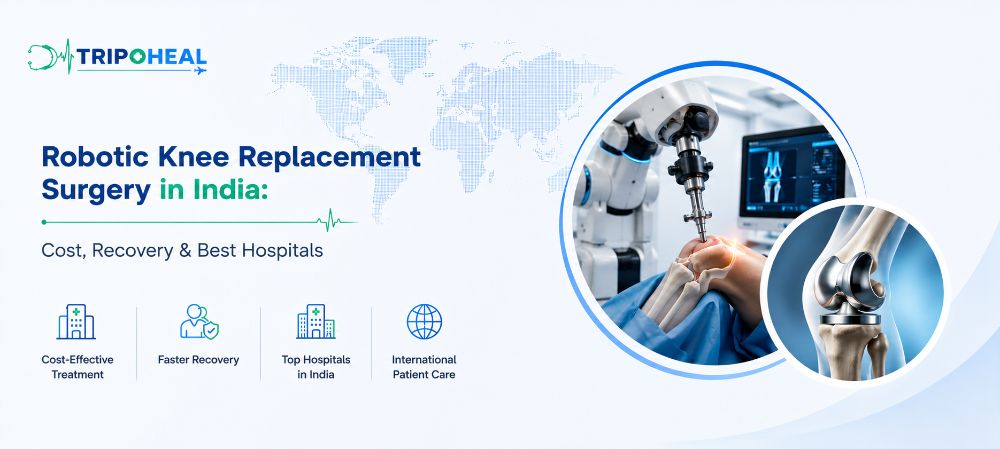
Robotic Knee Replacement Surgery in India Cost, Recovery & Best Hospitals (2026)
Robotic knee replacement surgery in India is a practical option for patients who need precise joint reconstruction but cannot absorb the $30,000–$50,000 price tag common in the US or UK. The same procedure at accredited hospitals across Delhi, Chennai, Mumbai, and Hyderabad starts from roughly ₹2,80,500 – enough of a difference to cover flights, accommodation, and post-operative physiotherapy with money left over. Across the patient journeys we coordinate at Tripoheal, one pattern holds consistently: patients who plan around a confirmed surgical date and a structured discharge protocol recover faster and with fewer logistical problems than those who arrange care on the fly. The difference between a smooth medical trip and a stressful one is almost entirely in the planning.
This guide covers what robotic knee replacement involves, how Indian hospitals differ in technology and process, what the full cost looks like broken down by city, and what a realistic recovery timeline requires. The numbers reflect 2026 pricing and current hospital capabilities.
Robotic knee replacement surgery in India offers international patients precision outcomes at a fraction of Western costs in 2026.
What robotic knee replacement surgery means for international patients arriving in India today
Robotic knee replacement uses a surgeon-controlled arm to make bone cuts and position the implant with sub-millimeter accuracy that manual technique cannot reliably match. For international patients, that precision translates to a shorter hospital stay and a faster return to movement. Patients who confirm their surgical date at least three weeks ahead move through pre-op imaging, surgery, and discharge with fewer delays.
A single knee starts at roughly ₹2,80,500 – compared to $30,000–$50,000 in the US or UK. That difference is enough to cover flights, accommodation, and post-op physiotherapy. Bilateral packages at accredited Delhi and Chennai hospitals run around ₹4,00,000 all-inclusive.
Hospitals across Delhi, Mumbai, Chennai, and Hyderabad run Mako and ROSA robotic systems with dedicated orthopedic surgery teams. Each system produces a patient-specific surgical plan before the first incision, which reduces intraoperative guesswork and keeps implant alignment consistent across surgeons and facilities.
What exactly are international patients booking when they choose robotic knee replacement surgery in India?
Booking robotic knee replacement surgery in India through us gives you a complete care pathway: CT-based pre-surgical planning, a computer-assisted procedure, and a rehabilitation protocol that begins on the day of surgery. The robotic system gives the surgeon real-time data and physical boundary enforcement that freehand technique cannot match. Packages at leading centers in Delhi NCR and Chennai start from ₹2,80,500 for a single knee, all-inclusive.
How the MAKO system works
A CT scan of the patient’s knee builds a 3D bone model. The surgeon uses it to set exact implant position, size, and alignment before the first incision. In theatre, the robotic arm tracks the actual bone in real time and applies haptic resistance if any instrument moves outside the planned safe zone. The system also maps the knee’s natural kinematics so the implant replicates the patient’s own joint mechanics, reducing the risk of post-operative stiffness or instability.
What happens on surgery day
The surgeon registers the patient’s bone landmarks against the CT model, confirming the digital plan matches physical anatomy. Bone preparation and implant seating then proceed with continuous positional guidance from the robotic arm. Theatre time averages 75 to 90 minutes for a single knee. Most patients stand and take supervised steps the same day–an intentional protocol that lowers deep vein thrombosis risk and shortens the hospital stay.
Why robotic precision reduces soft-tissue damage and implant misalignment
In conventional surgery, the surgeon uses physical jigs and visual landmarks to guide bone cuts. Even a two-degree deviation in tibial slope or femoral rotation can affect how the joint tracks over time. The robotic system enforces planned boundaries mechanically, producing smaller, more controlled cuts with less disruption to surrounding muscle and soft tissue. Less tissue trauma means less swelling, lower pain scores in the first 48 hours, and a faster return to independent walking–factors that matter to international patients who need to be medically stable before flying home.
Key clinical numbers
| Metric | Robotic | Conventional |
|---|---|---|
| Implant alignment accuracy | Within 1° of plan | 3–4° deviation range |
| Theatre time (single knee) | 75–90 minutes | 60–90 minutes |
| Median hospital stay | 3–4 days | 4–5 days |
| Walking unaided | By end of week 6 | 8–10 weeks typical |
| Full recovery | 3–6 months | 6–12 months |
How does robotic knee replacement at a premium Indian hospital differ from a standard knee replacement package?
The difference runs through every stage of care—from how the joint is measured before surgery to how quickly a patient walks afterward.
Side-by-side comparison: standard versus robotic knee replacement at Indian hospitals
| Factor | Standard Knee Replacement | Robotic Knee Replacement |
|---|---|---|
| Pre-op planning | X-ray and manual templating | 3D CT scan with patient-specific digital model |
| Bone cutting accuracy | Surgeon judgment and manual jigs | Robotic arm limits cuts to within 1 mm of plan |
| Soft tissue damage | Moderate – wider surgical field required | Reduced – smaller incision, less muscle disruption |
| First mobilization | Day 1–2 post-surgery | Same day as surgery in most cases |
| Hospital stay | 4–5 days average | 2–3 days average |
| Physiotherapy | Standard ward-based protocol | Accelerated protocol with dedicated physio team |
| Package cost (single knee, India) | ₹1,80,000–₹2,20,000 approx. | ₹2,50,000–₹3,50,000 approx. |
| Implant type | Standard off-the-shelf implant | Often imported, precision-sized to CT data |
Robotic packages at hospitals like Medanta or Fortis typically bundle the CT scan, robotic system fee, and accelerated physiotherapy. Standard packages often bill physiotherapy separately—a cost patients don’t always anticipate.
Pre-op imaging, intraoperative data, and post-op physiotherapy: where the quality gap shows
A CT scan produces a precise 3D map of the knee. The surgeon plans bone cuts digitally, and the robotic arm holds to those boundaries during surgery, preventing instruments from leaving the planned zone. The system also records real-time ligament balance data intraoperatively—something standard surgery cannot objectively confirm, regardless of surgeon skill.
After surgery, robotic packages typically begin physiotherapy within hours rather than the next morning. This supports the 2–3 day average stay and makes return travel easier for international patients.
Why the higher upfront cost often lowers total trip expenditure
A 4–5 day standard stay plus a longer rehabilitation period before flying adds accommodation, caregiver, and rebooking costs. A robotic package can cut the total in-country stay by 5–7 days. At ₹5,000–₹12,000 per night near major hospitals in Delhi or Mumbai, that saving is significant.
Revision risk matters too. Poor implant alignment can require a second surgery within 5–10 years—costs that far exceed the original price difference. Most package comparison tools don’t show this.
What “revision-risk reduction” actually means
It refers to a lower probability of needing corrective surgery due to implant malalignment. Robotic systems reduce angular deviation in implant placement, affecting long-term load distribution. This covers only revisions caused by technical placement errors—not those from infection, patient weight, or implant wear.
For patients who cannot easily return for a revision, that distinction matters. You can explore orthopedic surgeries available in India and discuss revision-risk specifics with our team before confirming a hospital.
How should international patients plan their surgery timeline, recovery stay, and post-op coordination in India?
Planning a robotic knee replacement in India means more than booking a flight and a hospital bed. The full sequence of pre-op assessment, surgery, in-hospital recovery, and discharge-ready physiotherapy takes a minimum of 14 days on the ground. Leaving earlier is the most common reason international patients run into complications after returning home.
Recommended stay duration: pre-op, surgery, and minimum recovery window
A single robotic knee replacement needs 14 to 18 days in-country. The first two days cover pre-operative workup: blood panels, CT scan for 3D implant planning, cardiology clearance if needed, and a surgeon consultation. Surgery is on day 3. Most patients stand and take assisted steps the same day, so the in-hospital stay is typically 3 to 4 nights. The remaining 10 to 12 days are for supervised physiotherapy, wound checks, and confirming the patient can safely board a long-haul flight–swelling controlled, knee bending past 90 degrees. Bilateral replacement adds 4 to 5 days. Patients who leave at day 7 often find their home physiotherapist has no baseline to work from, so the first two weeks back are spent catching up.
City-wise cost comparison for robotic knee replacement
Costs vary by city mainly because of hospital overhead, not surgeon skill or implant quality.
| City | Single Knee (approx.) | Notes |
|---|---|---|
| Delhi NCR (Gurugram, Noida) | ₹2,80,500–₹3,80,000 | Most competitive pricing; bilateral packages from ₹4,00,000 all-inclusive |
| Mumbai | 15–20% above Delhi | Higher real estate and staffing costs |
| Chennai | Comparable to Delhi | Strong international patient infrastructure; popular with Southeast Asia and Middle East patients |
| Bangalore / Hyderabad | ₹3,00,000–₹4,20,000 | Newer orthopedic centers with Mako and ROSA systems |
Choosing Apollo Chennai vs. Artemis Gurugram: credentials, Mako availability, and international support
Both hospitals have Mako SmartRobotics and are strong options, but they suit different patients. Artemis Hospital in Gurugram has Arabic and French-language international desk support, which suits patients from the Gulf and West Africa. It is JCI accredited with documented robotic knee volume. Apollo Chennai has a longer track record with patients from East Africa and the US, and its same-day mobilization protocols are well-established. The practical difference comes down to logistics: Gurugram is 30 minutes from Indira Gandhi International Airport; Chennai’s airport is close to the hospital but involves a longer connection for most US patients. At either facility, verify fellowship training in robotic joint replacement, annual robotic volume above 150 cases, and the hospital’s revision rate.
Post-op coordination checklist: physiotherapy handover, implant documentation, and follow-up from home
Before leaving India, patients should have four things in hand:
- A written physiotherapy protocol with week-by-week milestones from weeks 1 through 12, ready to share with the home physiotherapist.
- An implant card–physical and digital–with manufacturer, model, lot number, and size, needed for airport security and any future imaging or revision work.
- A radiology CD or cloud link with post-operative X-rays, formatted for a local orthopedic surgeon at the 6-week follow-up.
- Scheduled video consultations at 2 weeks and 6 weeks post-discharge with the operating surgeon’s team.
Patients who skip the 2-week video call are more likely to report avoidable issues–stiffness from under-exercising or swelling from over-exertion–that a 15-minute call would catch. Contact our team to discuss how post-discharge follow-up is structured for your situation.
Why does robotic knee replacement consistently outperform conventional surgery for medical tourists choosing India in 2026?
Patients traveling from the US, UK, or the Gulf to India for robotic knee replacement surgery are not simply chasing a lower price. They are choosing a procedure with a measurably smaller margin for surgical error, a recovery that fits a return-travel timeline, and a total cost that sits well below what a single consultation runs at home.
How pre-surgical 3D planning changes decision-making
Before surgery, the robotic system uses a CT scan to build a 3D model of the patient’s knee. The surgeon maps bone cuts, implant alignment, and soft-tissue balance on that model before the patient goes under anesthesia. By the time patients reach the consent stage, they have a concrete picture of what will happen–not a generic diagram–which cuts last-minute hesitation. For patients coordinating travel from Dubai, Nairobi, or New York, that certainty also helps logistically: the surgical plan is fixed, so departure dates can be set with confidence.
How robotic bone-cut precision improves implant survival
The robotic arm keeps the cutting instrument within the boundaries the surgeon defined before the operation. Traditional manual cutting relies on physical jigs and real-time judgment; even experienced surgeons can drift by a few degrees under fatigue or in difficult anatomy. Robotic systems reduce angular deviation to under one degree in most cases, placing the implant on the correct mechanical axis of the leg. That alignment determines how load distributes across the joint over time–a misaligned implant fails earlier. For patients in their 50s who need a replacement to last 20 years, that difference matters.
Success rates and early mobilization
At major hospitals in Delhi NCR, Chennai, and Hyderabad, roughly 85–90 percent of robotic knee replacement patients walk unaided within 48 hours of surgery–consistently higher than traditional cohorts at the same centers, where full weight-bearing typically takes three to five days. The robotic approach reduces soft-tissue disruption, so swelling and pain are lower and physiotherapy can start the same day. For a medical tourist with a fixed return ticket, that 48-hour mobilization window is the difference between a viable trip and an extended stay.
Cost breakdown for international patients
The base procedure runs ₹2,80,500–₹3,22,000 at accredited hospitals in Delhi, Gurgaon, and Chennai, covering surgery, robotic system usage, and standard anesthesia. Three add-ons bring the full package cost higher:
- Implant (imported brands): ₹60,000–₹90,000
- Hospital stay, 3–5 nights at ₹8,000–₹15,000 per night (private room)
- Physiotherapy sessions during admission
A realistic all-in figure for one knee with a four-night stay is ₹4,00,000–₹5,00,000–70–80 percent below US or UK pricing. Bilateral cases typically total ₹7,00,000–₹8,00,000. For a current estimate based on your diagnosis and preferred hospital, contact our team directly.
What are the most common questions patients ask before confirming their robotic knee replacement booking in India?
Is robotic knee replacement surgery in India safe for international patients travelling without a local support network?
Yes. Accredited hospitals in Delhi, Gurgaon, and Chennai assign dedicated international patient coordinators who handle discharge planning, interpreter services, and post-op follow-up, so you don’t need a local contact.
How does the total cost of robotic knee replacement in India compare to the UK, US, or Australia in 2026?
A single-knee robotic procedure in India costs roughly ₹2,80,000–₹5,00,000 all-in, against $30,000–$50,000 USD in the US – a saving of 70–80 percent for the same implant quality and accredited surgical teams.
Which Indian hospitals have the MAKO robotic system installed and accredited for international patient use?
Several JCI- and NABH-accredited hospitals across Delhi NCR, Chennai, and Hyderabad run the MAKO platform. We help patients match their diagnosis and budget to the right facility – explore orthopedic surgery options or contact our team for a current list.
What is the full recovery timeline after robotic knee replacement, and when can I fly home safely?
Most patients walk on the day of surgery and are medically fit to fly within 10–14 days. Full recovery, including return to normal activity, takes 3–6 months, with physiotherapy continuing at home after discharge.
Can both knees be replaced robotically in a single visit, and what does that do to cost and recovery time?
Yes, bilateral robotic knee replacement is done in one admission. All-inclusive bilateral packages start around ₹7,00,000–₹8,00,000, and recovery runs roughly 2–3 weeks longer than a single-knee procedure.
Do I need to bring my imaging scans from home, or will the hospital arrange a pre-operative CT scan in India?
Hospitals can arrange a fresh CT scan on arrival, which typically takes one day. Bringing existing X-rays or MRI reports from home speeds up the initial surgical assessment.
Updated May 2026. Based on live event observations and hospital pricing data compiled across Delhi NCR, Chennai, and Hyderabad facilities coordinated through Tripoheal.
Tripoheal works with international patients who are weighing robotic knee replacement surgery in India and need clear guidance on hospital selection, surgeon credentials, and full-trip coordination. We connect patients with accredited hospitals across Delhi NCR, Mumbai, Chennai, and Hyderabad that run established Mako robotic knee replacement programs, and we manage the logistics that typically hold up a medical trip – visa invitation letters, airport transfers, interpreter support, and post-discharge follow-up. If you are comparing options or ready to request a cost estimate, you can reach our coordination team directly through our contact page.