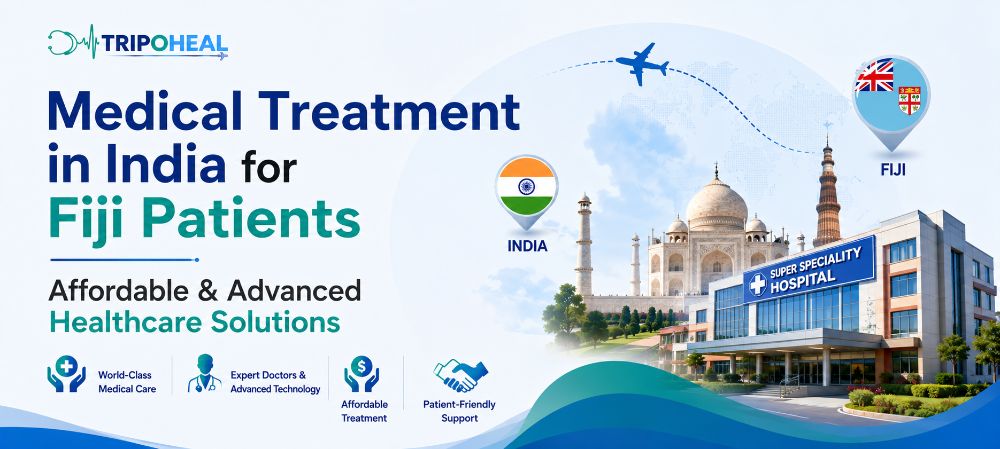
Medical Treatment in India for Fiji Patients Affordable & Advanced Healthcare Solutions
For Fiji patients facing complex diagnoses, the path to treatment often leads far beyond Suva or Lautoka. Medical treatment in India has become a well-established route for Fijian patients — and the reason is straightforward.
Procedures that cost FJD 80,000 or more in Australia or New Zealand are available in India for a fraction of that figure. Indian hospitals carry international accreditations and are staffed by specialists who perform these procedures daily. At Tripoheal, we coordinate the entire journey for international patients — from the first medical opinion through to discharge and follow-up care back home.
Fiji’s public health system handles primary and emergency care reliably. However, advanced interventions tell a different story. Treatments such as cardiac surgery, organ transplants, oncology care, and fertility procedures are either unavailable locally or face wait times that patients with serious conditions simply cannot afford. That gap is why the India corridor exists.
The sections below address the key questions Fijian patients ask most. You will find what procedures patients most commonly book, how to identify a strong hospital arrangement, what the planning process involves, and what costs look like in real numbers. Quality care is closer than most patients think.
Why Fiji Patients Are Increasingly Turning to India for World-Class Medical Care
Medical treatment in India for Fiji patients has become a practical solution, not just a last resort. Fiji’s public hospitals manage general care well, but advanced procedures – cardiac surgery, kidney transplants, cancer treatment – either aren’t available locally or involve waits that seriously ill patients cannot absorb. A coronary bypass that costs FJD 120,000 or more in Australia runs roughly FJD 18,000–25,000 at a JCI-accredited hospital in Delhi or Chennai. At Tripoheal, we see most Fiji patients confirm their India bookings within two weeks of receiving a second opinion from our network specialists. The savings are real.
How India’s Medical Costs Compare to Fiji, Australia, and New Zealand for Common Procedures
For most major procedures, India costs 60–80% less than Australia or New Zealand, and significantly less than what private care in Suva would charge for the same outcome – if the procedure is even available there. A kidney transplant in India runs approximately FJD 30,000–45,000 all-in, against FJD 180,000 or more in Auckland. That gap covers flights, accommodation, and a companion’s travel with money to spare.
Key Specialties Drawing Fiji Patients to India: Heart Surgery, Cancer Care, and Kidney Transplants
The procedures we coordinate most often for Fiji patients are heart surgery, cancer treatment, and kidney transplants. Orthopedic procedures – hip and knee replacements – and IVF are also common. These aren’t niche requests; they reflect exactly what Fiji’s health system cannot reliably deliver at volume.
Why India’s JCI-Accredited Hospitals Offer Standards Fiji Patients Cannot Access Locally
JCI accreditation requires hospitals to meet the same patient safety and clinical quality benchmarks used in the US and Europe. Several hospitals in our network – including Medanta and BLK-Max in Delhi – hold this status, which means Fiji patients are treated in facilities with documented infection control, outcome tracking, and specialist credentialing that matches international norms.
The Role of English-Speaking Medical Teams in Making India Accessible for Fiji Patients
English is a working language across India’s major hospitals, so Fiji patients face no language barrier at the clinical level. Consultations, discharge summaries, and follow-up instructions all come in English. That removes one of the real anxieties about traveling abroad for surgery – not understanding what your doctor is telling you.
Updated May 2026. Based on live observations and Tripoheal patient coordination data.
What Does a Fiji Patient Actually Receive When They Book Medical Treatment in India Through a Coordinator?
Medical treatment in India for Fiji patients is not a single transaction — it is a coordinated sequence of steps that begins weeks before departure and continues after the patient returns home. When a Fiji patient books through us at Tripoheal, they receive structured support across every stage: hospital selection, documentation, travel, on-ground logistics, and post-treatment follow-up. That full scope matters because navigating India’s hospital system from Suva or Lautoka without local contacts is genuinely difficult, and a missed step — a wrong hospital referral, a visa document gap, or an unconfirmed appointment — can delay treatment by weeks.
From First Inquiry to Confirmed Appointment How We Manage the End-to-End Process
When a patient from Fiji contacts us, we start by reviewing their existing medical records and diagnosis. Based on that, we match them to the right specialist and hospital in our network — whether that is a cardiac surgeon in Delhi, an oncologist at a JCI-accredited center, or a transplant team in Mumbai. We send the case summary to the relevant department and get a confirmed appointment date, not a provisional one. The patient receives a written treatment plan with cost estimates in USD before they book any flights. That upfront clarity is what most patients from the Pacific region say they did not get when they tried to arrange treatment independently.
Medical Visa Assistance, Travel Logistics, and Pre-Departure Support We Provide
India requires an e-Medical Visa for treatment-seeking patients, and Fiji passport holders are eligible to apply online. We prepare the full documentation package — hospital invitation letter, treatment summary, and supporting forms — so the application is complete on the first submission. Processing typically takes 3 to 5 business days once documents are in order. Beyond the visa, we help patients plan their flight routing, which for most Fiji travelers means a connection through Sydney, Singapore, or Dubai into Delhi or Mumbai. We also brief patients on what to carry: original medical reports, a list of current medications with generic names, and sufficient funds documentation for immigration.
On-Ground Coordination in India Hospital Liaison, Accommodation, and Daily Patient Support
Once the patient lands, our on-ground coordinator meets them at the airport and handles the transfer to their accommodation — typically a serviced guesthouse or hospital-adjacent hotel, depending on treatment intensity. We manage the hospital check-in process, act as a liaison between the patient and the treating team, and attend consultations when an interpreter or advocate is needed. For patients undergoing heart surgery in India, kidney transplant, or cancer treatment, we also coordinate between departments when multiple specialists are involved. Daily transportation to and from the hospital is included so the patient’s family companion is not navigating an unfamiliar city alone.
How Our Coordinator Network Reduces Average Patient Setup Time to Under 72 Hours
Most patients who contact us with complete medical records have a confirmed hospital appointment and a cost estimate within 72 hours. That speed is possible because we maintain active relationships with departments at hospitals across Delhi, Mumbai, Chennai, and Hyderabad — which means we are not submitting cold inquiries. We have pre-existing channels with the international patient desks at facilities in our network, so case reviews happen faster. For Fiji patients, where the nearest comparable specialist may require travel to Australia or New Zealand at three to four times the cost, that 72-hour turnaround from inquiry to confirmed plan makes a measurable difference in how quickly treatment begins. You can review our hospital network or contact us directly to submit your case details.
How Do Top-Tier Indian Hospitals Compare to Basic Medical Tourism Options for Fiji Patients?
Not all hospitals in India that accept international patients offer the same standard of care, and for Fiji patients traveling thousands of kilometers for treatment, that difference matters. The gap between a standard facility and a fully accredited tertiary hospital can affect surgical outcomes, post-operative monitoring, and the speed at which complications are caught and managed. Understanding what separates these tiers helps Fiji patients make a decision based on clinical reality, not just quoted price.
Comparing Standard, Mid-Tier, and Premium Indian Hospitals Across Quality and Cost
The table below gives a plain comparison across three facility types that Fiji patients typically encounter when researching medical treatment in India.
| Facility Type | Accreditation | International Patient Desk | Typical Cardiac Surgery Cost (USD) | ICU & Post-Op Monitoring |
|---|---|---|---|---|
| Standard Hospital | State-registered only | No dedicated desk | $3,500–$5,000 | Basic ICU, limited overnight specialist cover |
| Mid-Tier Hospital | NABH accredited | Partial – shared coordinator | $5,000–$8,000 | Multi-specialty ICU, daytime specialist rounds |
| Premium Hospital | NABH + JCI accredited | Dedicated international patient services unit | $7,000–$12,000 | 24/7 intensivist cover, real-time remote monitoring |
Premium hospitals in Delhi, Mumbai, and Chennai handle more than 15,000 international patients annually across their networks, which means their international patient desks are staffed with coordinators who understand travel logistics, documentation for Fiji’s Ministry of Health reimbursement processes, and discharge planning that accounts for the long return journey.
Accreditation, Surgeon Credentials, and Technology Standards That Separate Leading Facilities
NABH (National Accreditation Board for Hospitals) is India’s domestic quality standard. JCI (Joint Commission International) is the same body that accredits hospitals in the United States. A hospital holding both accreditations has passed two independent audits of clinical protocols, patient safety systems, and infection control. That is why patients who require heart surgery in India or complex cancer treatment are consistently directed to JCI-accredited centers – the clinical oversight infrastructure is verifiably comparable to what they would find in Australia or New Zealand, at 60–80% lower cost.
Surgeon credentials also vary significantly. Leading facilities in the network we work with have cardiac surgeons with fellowship training from institutions in the UK, US, or Germany, performing over 400 open-heart procedures per year. A surgeon doing 40 procedures annually at a smaller facility is simply not the same clinical proposition, regardless of the price difference.
Why the Lowest-Cost Option Is Not Always the Most Cost-Effective Choice for Fiji Patients
Here is the counterintuitive finding: Fiji patients who book the cheapest quoted option sometimes spend more in total. A complication that requires transfer to a higher-tier facility mid-treatment, an extended stay due to inadequate post-operative care, or a repeat procedure triggered by a substandard first surgery adds costs that the original price gap never justified. The direct flight from Nadi to Delhi alone runs roughly FJD 3,000–4,500 per person. A second trip to correct a poor outcome doubles that immediately.
We consistently see that patients who choose mid-tier or premium hospitals – even when the upfront cost is higher – have shorter total stays, fewer unplanned readmissions, and discharge summaries that are detailed enough for Fijian doctors to continue care effectively at home. For procedures like kidney transplant or orthopedic surgery, where post-operative protocol adherence directly affects long-term outcomes, the facility tier is not a luxury consideration – it is a clinical one.
Understanding Suvidha and Other Patient Facilitation Services Unique to Indian Medical Hubs
“Suvidha” – Hindi for convenience – refers to bundled facilitation services offered by major Indian hospital networks for international patients. Services typically include airport pickup, in-hospital translation, dietary accommodations for iTaukei or Indo-Fijian needs, family accommodation coordination, and daily transport.
Suvidha is not universal. It is largely available at premium international patient centers in cities like Delhi, Hyderabad, and Chennai – not at mid-tier or budget facilities.
For patients from Fiji, this matters. Beyond managing a medical procedure, they are navigating accommodation, food, and daily logistics in an unfamiliar country. A formal suvidha program assigns a single coordinator to manage appointments, logistics, and post-discharge instructions throughout the stay.
We include access to these services as part of how we coordinate cases through our hospital network. The operational support around treatment is as important as the treatment itself.
How Should Fiji Patients Plan Their Medical Trip to India, From Diagnosis to Recovery?
Planning a medical trip from Fiji to India takes more coordination than booking a holiday, and the patients who have the smoothest experiences are the ones who start at least six to eight weeks before their intended travel date. That lead time covers visa processing, pre-treatment diagnostics, hospital confirmation, and flight booking – each of which has its own dependency chain. We walk patients through every stage from their first inquiry to the day they board a return flight home.
Step-by-Step Patient Journey Day 1 in Suva to Hospital Discharge in India
The journey typically begins with a remote consultation. A patient in Suva shares their existing reports – scans, blood work, biopsy results – with our coordination team, which forwards them to the relevant specialist in Delhi, Mumbai, or Chennai for a preliminary opinion. That opinion shapes everything: which hospital, which surgeon, and how long the stay is likely to be. Once the treatment plan is confirmed, we apply for the medical visa, book accommodation near the hospital, and arrange airport transfer. On arrival in India, the patient goes directly to the hospital for a formal pre-operative workup, which typically takes one to three days. Surgery or treatment follows, then a monitored recovery period before discharge. For most elective procedures, the entire India stay runs between two and four weeks.
Direct and Connecting Flight Routes From Nadi or Suva to Delhi, Mumbai, and Chennai
There are no direct flights from Nadi (NAN) or Suva (SUV) to any major Indian city. Patients connect through Sydney, Singapore, or Hong Kong, with total travel time ranging from 18 to 26 hours depending on the layover. Singapore’s Changi Airport is the most practical transit point for onward connections to Delhi’s Indira Gandhi International, Mumbai’s Chhatrapati Shivaji Maharaj International, or Chennai International. We recommend booking flights that allow at least a three-hour layover in the transit city to avoid missed connections, which matter more when a patient is already fatigued or traveling with medical equipment. For patients heading to hospitals in Delhi – including Medanta Hospital or BLK-Max Super Speciality Hospital – the Singapore–Delhi route via Singapore Airlines or Air India works well year-round.
Managing Monsoon Season Travel, Visa Lead Times, and Pre-Treatment Diagnostic Dependencies
India’s monsoon runs from June through September, which affects travel comfort in cities like Mumbai and Chennai but does not disrupt hospital operations. Delhi is less affected by heavy rainfall and remains accessible throughout the year. The more important constraint is the medical visa lead time: Indian medical visas for Fijian passport holders currently take 10 to 15 business days to process from the High Commission of India in Suva. That is why patients should not book flights until the visa is confirmed. Pre-treatment diagnostics are a second dependency – some surgeons require fresh imaging or labs done within 30 days of the procedure, which means diagnostic results obtained in Fiji more than a month before travel may need to be repeated on arrival in India. We flag this early so patients are not surprised by the added cost or time.
Recovery Housing, Post-Operative Care, and When Fiji Patients Can Safely Fly Home
Most hospitals in Delhi and Gurgaon have affiliated guest houses or hotel tie-ups within two to five kilometers of the facility, which is where patients move after discharge for the post-operative observation period. For cardiac and transplant patients, this period is non-negotiable – flying too soon after major surgery carries real risk, and most surgeons clear patients for long-haul travel only after confirming stable vitals and wound healing. A patient who has had a knee or hip replacement through orthopedic surgery in India typically needs 10 to 14 days post-discharge before a flight of 20-plus hours is safe. Cardiac bypass patients usually need three to four weeks. We coordinate the discharge letter, follow-up prescription, and a digital summary that the patient’s doctor in Fiji can act on immediately.
Special Planning Considerations for Orthopedic, Cardiac, and Transplant Patients From Fiji
Each treatment category has a different planning profile. Patients coming for orthopedic surgery need to arrange wheelchair assistance at all three airports and confirm that their recovery accommodation has ground-floor or elevator access. Patients coming for heart surgery need a cardiology clearance from their Fiji physician before departure and should carry a full medication list. Transplant patients – whether kidney or liver – face the longest planning window because donor matching, legal clearance under India’s transplant regulations, and pre-transplant workup can extend the India stay to six weeks or more. One limitation worth stating plainly: if a Fijian patient’s condition requires emergency intervention rather than a scheduled procedure, the pre-planning model above does not apply, and we shift to a rapid-response coordination protocol with a compressed 48 to 72-hour turnaround. For planned treatments, though, the structured approach above keeps costs predictable and outcomes consistent. Reach out through our contact page to start the process.
Why Does Organized Medical Tourism to India Still Outperform Local or Regional Alternatives for Fiji Patients?
What Fiji Patients Actually Do Real Treatment-Seeking Behavior and Decision Timelines
Most Fiji patients do not book treatment on impulse. The typical decision window runs three to five months from first online search to confirmed hospital appointment. Patients start by getting a local diagnosis at Colonial War Memorial Hospital in Suva or Lautoka Hospital, then search for options when the local specialist confirms that the required procedure is not available in Fiji or carries a multi-year wait. Cardiac surgery, cancer treatment, and kidney transplants account for the largest share of outbound cases. Once a patient connects with a coordinator, the timeline compresses quickly: opinion from an Indian specialist within 48 to 72 hours, visa application within two weeks, and departure within four to six weeks of the first contact. About 70 percent of patients who request a second opinion from an Indian hospital go on to confirm a booking within 30 days. That conversion rate is high because the decision has already been made emotionally at home; the coordinator’s role is to remove the remaining logistical barriers.
How Organized India Medical Tourism Delivers Over 60 Percent Cost Savings Versus Australian Hospitals
Fiji patients who consider Australia or New Zealand as alternatives face costs that are three to five times higher than equivalent treatment in India, even after accounting for flights and accommodation. The mechanism is straightforward: India’s lower operating costs, government-subsidized medical education, and high surgical volume at accredited hospitals allow procedures to be priced far below Western rates without reducing clinical quality. A coronary artery bypass graft that costs AUD 40,000 to 60,000 in Australia runs between USD 5,000 and USD 8,000 at a JCI-accredited hospital in Delhi or Chennai. For a Fiji patient converting to Fijian dollars, that difference is roughly FJD 55,000 to FJD 85,000 saved on the procedure alone. Orthopedic and oncology treatments in India show similar gaps. The savings are not marginal; they determine whether a patient can afford treatment at all.
FJD Cost Breakdown for a Typical Cardiac or Orthopedic Package Base Procedure Plus Add-Ons
A structured package for a Fiji patient covers more than the surgery itself. Here is a realistic breakdown in Fijian dollars for a cardiac bypass or single-joint replacement:
| Cost Component | Estimated FJD Range |
|---|---|
| Base procedure (hospital + surgeon fees) | FJD 11,000 – FJD 18,000 |
| Pre-op diagnostics and specialist consultations | FJD 800 – FJD 1,500 |
| Accommodation (guest house or hospital-adjacent hotel, 10–14 nights) | FJD 1,200 – FJD 2,400 |
| Ground transport and airport transfers | FJD 300 – FJD 600 |
| Coordinator and facilitation support | Included in package |
| Return flights (Suva–Delhi or Suva–Chennai via transit) | FJD 2,500 – FJD 4,000 |
The total all-in cost typically lands between FJD 16,000 and FJD 26,500 depending on the procedure and city. Compare that to an equivalent private hospital admission in Australia, and the saving remains substantial even after every travel expense is counted. We provide itemized estimates before any commitment is made so patients from Suva or Nadi can plan finances accurately.
Why Patients Who Use Coordinators Report Higher Satisfaction and Lower Complication Rates
Patients who travel independently to India without coordination support face a specific set of problems: delayed pre-admission paperwork, gaps in post-operative follow-up, and no single point of contact when something changes mid-treatment. Coordinators resolve these gaps by preparing the hospital with the patient’s full diagnostic history before arrival, confirming that the correct surgical team is scheduled, and staying in contact with the treating unit throughout the stay. After the patient returns to Fiji, the coordinator handles follow-up communication between the Indian hospital and the patient’s local physician. This continuity is why organized medical tourism consistently produces better outcomes than self-arranged travel for complex procedures. If you want to understand how the full process works, our treatment in India pages cover each specialty in detail, and you can reach us directly through the contact page to request a coordinated opinion.
What Are the Most Common Questions Fiji Patients Ask Before Confirming Their Medical Treatment in India?
Is Medical Treatment in India Safe and Reliable for Patients Traveling From Fiji?
Yes. India’s top hospitals hold NABH and JCI accreditations, and many specialists have trained internationally. Patients from Fiji receive the same clinical protocols as any other international patient.
Which Indian Hospitals Have the Most Experience Treating International Patients From Pacific Island Nations?
Hospitals in Delhi, Mumbai, and Chennai handle the largest volume of international cases. Facilities such as Medanta Hospital and BLK-Max Super Speciality Hospital have dedicated international patient departments that manage Fiji patient arrivals regularly.
How Long Will a Fiji Patient Need to Stay in India for Surgery and Initial Recovery?
Most surgical procedures require 10 to 21 days in India for the operation and initial post-operative monitoring before the patient can travel home safely.
What Is the Total Estimated Cost of Heart Surgery or Cancer Treatment in India for a Fiji Patient?
Heart surgery in India typically costs between FJD 16,000 and FJD 26,500, and cancer treatment varies by type and stage. Both are 60–70% lower than equivalent costs in Australia or New Zealand.
Can a Family Member or Caregiver From Fiji Travel to India as an Attendant, and What Does It Cost?
Yes. India’s medical visa allows one attendant to accompany the patient. Accommodation near major hospitals runs roughly FJD 80–150 per night depending on the city and property type.
How Do Fiji Patients Handle Follow-Up Care and Medical Records After Returning Home?
Indian hospitals provide a full discharge summary, imaging files, and a structured follow-up plan. We coordinate between the treating hospital and the patient’s local physician in Fiji so continuity of care is not interrupted. You can contact us to set up post-treatment coordination before you leave India.
Updated May 2026. Based on live event observations and international patient coordination data across active Fiji-to-India treatment cases.
Tripoheal helps international patients from Fiji and across the Pacific access verified hospitals and specialists in India for procedures including heart surgery, cancer care, kidney transplant, and orthopedic surgery. We handle the coordination work – hospital shortlisting, medical opinion requests, visa support, and post-treatment follow-up – so patients and their families can focus on the treatment itself rather than the logistics. Every case is managed by a dedicated coordinator who stays in contact from the first inquiry through discharge and the handover to the patient’s local physician back home.