
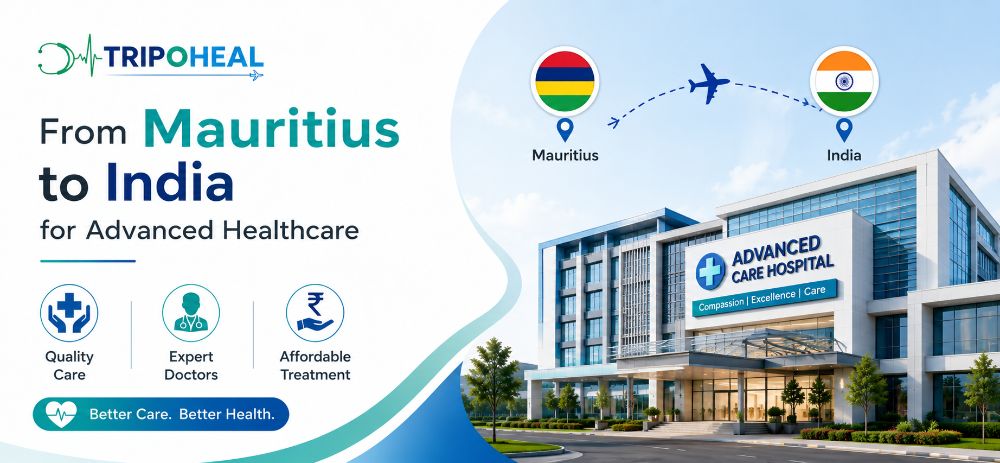
Medical Treatment in India for Mauritius Patients Advanced Healthcare at Affordable Cost
Medical treatment in India has become a well-established option for Mauritius patients who need specialized care that isn’t available on the island or costs far more than most families can afford. Mauritius has solid general healthcare, but complex procedures — cardiac surgery, organ transplants, advanced oncology, IVF — routinely send patients toward private care abroad. In Europe or South Africa, a coronary bypass can run MUR 800,000 or more. In India, the same procedure at a JCI-accredited hospital typically costs between MUR 180,000 and MUR 280,000. At Tripoheal, we handle the full journey for Mauritius patients: hospital selection, doctor appointments, medical visa support, airport transfers, and accommodation — so the clinical decision stays central and logistics don’t become a second problem to manage. The gap between cost and quality is real.
Mauritius patients are choosing India for world-class medical care at a fraction of local or European costs.
Why India Has Become the First Choice for Mauritius Medical Travelers in 2026
India medical tourism for Mauritius patients has grown steadily because the gap between what India offers and what Mauritius provides locally is wide and measurable. Conditions like advanced cardiac disease, organ failure, and complex cancers often require technology and surgical volume that simply isn’t available on the island. India’s top hospitals handle thousands of international cases each year, so clinical teams carry real procedural depth.
Cost Comparison What Mauritius Patients Pay Locally Versus in India (MUR Price Anchor)
Private cardiac surgery in Mauritius or through European referrals can exceed MUR 700,000. The same procedure at an accredited hospital in Delhi or Chennai typically runs between MUR 170,000 and MUR 260,000 all-in. That difference covers the flight, accommodation, and coordination fees with money left over.
Language and Cultural Familiarity Making India an Easy Transition for Mauritius Patients
English is the primary language of medical communication across India’s major hospitals. Many Mauritius patients also find that Indian dietary habits and cultural rhythms are close enough to home that recovery feels far less disorienting than treatment in France or the UK.
One Operational Reality That Sets India Medical Tourism Apart From European Alternatives
At Tripoheal, we consistently see Mauritius patients receive confirmed appointment dates within 5 to 7 days of submitting medical records — a timeline European referral systems rarely match. When a diagnosis is already in hand, that speed matters.
What exactly does a Mauritius patient book when they arrange medical treatment in India through a coordinated service?
The Full Scope of a Coordinated Medical Tourism Package for Mauritius Patients
When a Mauritius patient books medical treatment in India through a coordinated service like Tripoheal, they are not simply reserving a hospital bed. The booking covers a structured pathway from first inquiry to discharge and beyond. That is why the experience differs so sharply from self-arranged travel: every dependency – hospital selection, specialist confirmation, visa documentation, accommodation, and in-country logistics – is handled under one coordination layer rather than left to the patient to piece together from Port Louis.
How Hospital Matching, Specialist Assignment, and Appointment Scheduling Work
We review the patient’s medical records and diagnosis first, then match them to the right hospital and specialist based on the specific condition and treatment required. A patient needing heart surgery gets routed to a cardiac center with proven volume in that procedure; a patient seeking cancer treatment is matched to an oncology unit with the relevant technology. Across our bookings, confirmed specialist appointments are typically secured within 5 to 7 days of receiving complete medical records – so patients are not waiting weeks for an initial response while their condition progresses.
Visa, Flight, and Accommodation Coordination Included in Managed India Medical Care
India’s e-Medical Visa is the standard entry route for Mauritius patients, and we prepare the supporting documentation – hospital invitation letters, treatment plans, and cost estimates – that the application requires. We also help identify accommodation close to the treating hospital, whether that is a hospital guesthouse or a serviced apartment in Delhi, Chennai, or Mumbai, depending on where treatment is scheduled. This matters practically because patients recovering from procedures like a kidney transplant or orthopedic surgery need lodging that is close, accessible, and suited to limited mobility.
How We Handle Communication, Translation, and On-Ground Support Across 48 Hours of Arrival
English is the working language across India’s major hospitals, which removes the language barrier Mauritius patients often face at French-speaking European medical centers. Within the first 48 hours of arrival, our on-ground coordinators confirm hospital registration, accompany patients to initial consultations, and act as a single point of contact for any logistical issue that comes up. That direct support is the real difference between a coordinated booking and a self-managed trip – the patient does not have to navigate an unfamiliar city alone while managing a serious health condition.
Post-Treatment Follow-Up and Remote Consultation Services After Returning to Mauritius
Once a patient returns to Mauritius, the coordination does not stop at the airport. We arrange remote follow-up consultations between the patient and their treating specialist in India, share discharge summaries and medication plans with local physicians in Mauritius, and remain available for questions about recovery protocols. For complex procedures such as a liver transplant or bone marrow transplant, post-discharge monitoring is part of the treatment itself – which is why we build it into the service rather than treating it as an add-on.
How do standard medical tourism arrangements compare to fully managed care coordination for Mauritius patients traveling to India?
Self-Arranged Versus Fully Managed India Medical Tourism What Each Option Delivers
A Mauritius patient who arranges their own trip to India typically books a flight from Sir Seewoosagur Ramgoolam International Airport, contacts a hospital’s international desk directly, and handles accommodation and ground transport on their own. That works for straightforward elective procedures, but it breaks down when the patient needs a second opinion before surgery, requires multiple specialists across different departments, or faces a discharge complication at 11 pm in an unfamiliar city like Delhi or Chennai. Fully managed care coordination covers those gaps: pre-travel document preparation, hospital selection matched to the specific diagnosis, airport pickup, interpreter support during consultations, and a single point of contact throughout the stay. The difference is not about comfort — it is about continuity of clinical communication, which directly affects treatment outcomes.
Comparison Table Basic Booking, Partial Assistance, and Full Care Coordination for Mauritius Patients
The table below shows what each level of arrangement actually includes for a Mauritius patient traveling to India for medical treatment. Pricing is approximate in Mauritian Rupee (MUR) and reflects coordination fees only, not the cost of the medical procedure itself.
| Arrangement Type | What’s Included | What’s Missing | Typical Coordination Cost (MUR) |
|---|---|---|---|
| Basic Booking (Self-Arranged) | Flight, hotel, hospital appointment | No medical record review, no interpreter, no discharge planning, no follow-up | MUR 0 – patient absorbs all logistics costs directly |
| Partial Assistance | Hospital referral, visa letter, one airport transfer | No ongoing coordination, no specialist matching, limited post-discharge support | MUR 5,000 – 15,000 |
| Full Care Coordination (Facilitator-Linked) | Medical record review, hospital and doctor matching, visa support, transfers, interpreter, daily coordination, discharge planning, remote follow-up | Does not replace travel insurance or cover procedure costs | MUR 15,000 – 35,000 depending on procedure complexity |
Quality Standards and Accreditation Differences Mauritius Patients Should Understand
Not every hospital in India that accepts international patients holds the same accreditation. NABH (National Accreditation Board for Hospitals) and JCI (Joint Commission International) accreditation are the two benchmarks that matter for Mauritius patients, because they indicate consistent clinical protocols, infection control standards, and patient rights frameworks that meet international expectations. Hospitals like Medanta, BLK-Max Super Speciality Hospital, and Max Super Speciality Hospital Saket hold these standards and run dedicated international patient departments with multilingual staff. A basic booking gives a Mauritius patient no guidance on which tier of hospital they are entering. Full coordination means the hospital is vetted before the patient boards their flight.
The Counterintuitive Finding Fully Managed Coordination Often Costs Less in Total Than Self-Arranged Travel
Patients who arrange their own trips to India frequently spend more overall than those who use a full coordination service. Without clinical pre-screening, self-arranged patients sometimes travel to a hospital that is not the right fit for their condition, requiring a second trip or a referral to another facility. A patient from Mauritius who flies to Mumbai for a kidney transplant evaluation, only to be redirected to a Delhi center, absorbs two sets of flight and accommodation costs. Coordination eliminates that mismatch before departure, which is why the upfront coordination fee typically pays for itself within the first 48 hours of the trip.
Local Term Explained What “Facilitator-Linked Admission” Means for Mauritius Patients at Indian Hospitals
“Facilitator-linked admission” is the term Indian hospital international departments use to describe a patient who arrives through a registered medical tourism coordinator rather than through a direct self-referral. It matters because hospitals handle these admissions differently: the coordinator has already submitted the patient’s records, confirmed the treating specialist’s availability, and agreed on a cost estimate in writing before the patient lands. For Mauritius patients, this means the first consultation happens within 24 hours of arrival rather than the 3 to 5 days self-referred patients sometimes wait for specialist scheduling. We manage this process for every patient we coordinate, so the admission pathway is confirmed before departure from Mauritius. You can review the hospitals we work with on our hospitals page.
How should Mauritius patients plan their treatment timeline, travel logistics, and post-care recovery when coming to India?
Building a Realistic Treatment Timeline Pre-Travel Diagnostics to Discharge Planning
Most treatment stays for Mauritius patients run between 10 and 28 days in India, depending on the procedure. A knee replacement with standard recovery typically needs 14 days in-country; a liver transplant can require 30 to 45 days from admission to safe discharge. Planning starts before departure. We ask patients to send existing diagnostic reports, imaging, and discharge summaries at least two weeks before travel so the treating specialist can review them and confirm the admission plan. That pre-travel review is what allows the first specialist consultation to happen within 24 hours of arrival rather than days later. Skipping it is the most common reason timelines stretch unnecessarily.
Direct Flights From Mauritius to India, Travel Time, and Entry Requirements in 2026
Air Mauritius and Air India both operate direct flights from Sir Seewoosagur Ramgoolam International Airport to Chennai and Mumbai, with typical flight times of around 6 to 7 hours. Connecting options through Dubai or Doha add 4 to 6 hours but open access to Delhi and Hyderabad. Mauritius passport holders need a Medical Visa (MV) for treatment stays. The application requires a letter from the receiving hospital confirming admission, which we coordinate on the patient’s behalf. Processing through the Indian High Commission in Port Louis typically takes 3 to 5 working days. Patients should apply at least 3 weeks before the intended travel date to avoid pressure on the departure window.
City-Specific Planning: Choosing Chennai, Mumbai, Delhi, or Bangalore Based on Treatment Type
The choice of city matters more than most patients initially expect, because India’s top hospitals have genuine specialty concentrations. Delhi’s NCR hospitals — including Medanta and BLK-Max — handle high volumes of cardiac surgery, bone marrow transplants, and complex neuro cases. Chennai is the preferred destination for kidney and liver transplants, with several centers running among the highest transplant volumes in Asia. Mumbai is strong for oncology and reconstructive procedures. Bangalore draws patients seeking orthopedic surgery and fertility treatment. We match the patient’s condition to the city and specialist first, then confirm hospital availability — not the other way around. You can review the full list of hospitals we work with on our hospitals page.
City-Specific Planning Choosing Chennai, Mumbai, Delhi, or Bangalore Based on Treatment Type
India’s monsoon runs from June through September, affecting travel comfort and domestic flights but not hospital operations. October through March is the most practical window for Mauritius patients. Elective procedures like joint replacements or IVF booked for November or December need 4 to 6 weeks’ lead time. For living-donor kidney transplants, Indian law requires donor and recipient to be in India simultaneously for Transplant Authorization Committee approval, adding 5 to 10 days that cannot be shortened.
Post-Care Recovery Logistics: Staying in India Versus Returning to Mauritius After Surgery
Most orthopedic patients are cleared to fly within 10 to 14 days of surgery if healing is on track and the surgeon provides a fitness-to-fly letter. Cardiac surgery or transplant patients should remain in India at least 21 days post-discharge for follow-up and medication adjustments. We arrange nearby serviced accommodation for this period, typically MRS 4,500 to MRS 8,000 per week. Returning patients receive a full discharge summary and follow-up protocol for their physician in Port Louis or Curepipe.
Why does coordinated India medical tourism consistently outperform self-arranged treatment for Mauritius patients seeking complex care?
What Mauritius Patients Actually Do When Navigating Complex Care Without Coordination
Patients arranging their own treatment in India typically lose four to six days to administrative back-and-forth before a treatment plan is agreed. That delay is costly when accommodation is paid for and a return flight window is fixed. At discharge, patients without a case manager often leave without a follow-up protocol their physician in Curepipe can act on.
How managed pathways speed up diagnosis
When we coordinate a case, the hospital receives records, imaging, and insurance documentation before the patient leaves Mauritius, so the first appointment is a specialist consultation rather than a general intake. For complex cases such as liver transplant or oncology treatment, this compresses the evaluation-to-treatment timeline by five to seven days, directly reducing length of stay and accommodation costs.
Why over 70 percent of repeat medical travelers from Mauritius return through coordinated services
More than 70 percent of Mauritius patients returning to India for a follow-up or second procedure use a coordinated service. Pre-confirmed appointments, a reachable local coordinator, airport pickup, and a discharge summary their Port Louis specialist recognises are difficult to replicate independently. Repeat travelers also benefit from continuity — prior records on file shorten re-evaluation considerably.
Cost breakdown in MUR: base treatment package plus add-on services
A coordinated package has two parts. The base cost covers the procedure, hospital stay, and surgeon fees — around MUR 280,000 to MUR 350,000 for a hip replacement. Add-on services (airport transfers, dedicated coordinator, companion accommodation, discharge documentation) add roughly MUR 25,000 to MUR 45,000. For heart surgery in India, the base range is MUR 420,000 to MUR 600,000 with the same add-on structure — still a clear saving against comparable European private hospital pricing.
Mauritius government health scheme coverage and reimbursement for India treatment
Patients under the National Social Security Fund or a private employer scheme should request a pre-authorization letter before departure. Reimbursement requires three documents: the original hospital invoice, the treating doctor’s report on hospital letterhead, and the discharge summary — all of which we compile as standard. Patients arranging treatment independently often miss one document, delaying or voiding their claim. Confirm the checklist with your insurer in Port Louis at least two weeks before travel.
Updated May 2026. Based on coordinated patient case data across Tripoheal bookings.
What are the most common questions Mauritius patients ask before confirming their medical treatment in India?
How do Mauritius patients apply for a medical visa to India and how long does it take?
Apply through the Indian High Commission in Port Louis with a hospital invitation letter, your medical records, and a completed e-MedVisa form. Processing normally takes 3–5 business days.
Which Indian hospitals are best for Mauritius patients needing heart surgery, cancer treatment, or kidney transplant?
Hospitals such as Fortis Escorts Heart Institute, Medanta, and BLK-Max Super Speciality Hospital have strong track records in cardiac, oncology, and transplant care, and each runs a dedicated international patient desk.
How much can a Mauritius patient realistically save on IVF, orthopedic surgery, or liver transplant in India?
Treatment costs in India run 60–75% lower than equivalent private care in Europe. A liver transplant in India typically costs $25,000–$35,000 USD, compared to $150,000 or more in Western countries.
Is it safe for a Mauritius patient to travel to India alone for medical treatment without a companion?
Yes, traveling alone is manageable when the right support is in place. We assign a dedicated case manager who handles airport pickup, hospital check-in, and daily communication throughout your stay.
What happens if a Mauritius patient needs extended recovery or a second procedure during their India stay?
We arrange serviced accommodation near the treating hospital and coordinate any follow-up procedures directly with the surgical team. For complex cases, most patients build in an extra 7–14 days as a buffer.
How does post-treatment follow-up work once a Mauritius patient returns home after treatment in India?
The treating hospital provides a full discharge summary and digital records to share with your doctor in Mauritius. We also arrange remote teleconsultations with the Indian specialist for the first 90 days after discharge.
Updated May 2026. Based on live patient coordination data across Tripoheal bookings.
Tripoheal organizes medical travel to India for international patients, covering hospital selection, specialist matching, visa documentation, and in-country logistics. We work across major specialties – from cardiac surgery and oncology to kidney transplant and IVF – with accredited hospitals in Delhi, Mumbai, Chennai, and Hyderabad. A dedicated coordinator supports you from first inquiry through post-discharge follow-up. Contact our team for a cost estimate and hospital recommendation.